
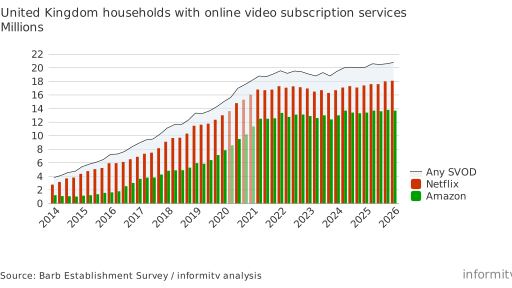
For the first time, over 70% of homes in the United Kingdom have access to an online video subscription service. For some time, the proportion had bounced around two-thirds of homes. Although recent rises are incremental, with a year-on-year increase of about 700,000 homes, the percentage of all homes is psychologically significant.
The establishment survey from the media measurement organisation Barb shows that 20.8 million homes in the United Kingdom had access to an online video subscription service in the first quarter of 2026. That is 70.3% of homes, up from 20.6 million in the last quarter of 2025, when it was 69.7%.
Netflix was available in an estimated 18.1 million homes across the country, which is 61.0%, up from 18.0 million the previous quarter. 7.2 million homes, or 40% of Netflix homes were on its advertising supported tier, an increase from 38% in the previous quarter.
Amazon Prime Video was in 13.7 million homes, or 46.1% of homes in the United Kingdom, down slightly from 13.8 million the previous quarter. 12.0 million homes, or 88% of Amazon Prime Video homes in the country, were on its advertising tier, up slightly from 11.9 million the previous quarter.
Disney+ was available in 7.8m homes, or 26.1%, up from 7.6m in a quarter. 2.8 million, or 37% of Disney+ homes, were on its advertising tier.
Discovery+ was up slightly at 3.5 million homes or 11.8%. Paramount+ was flat at around the same number.
Apple TV was available in 3.1 million homes, 10.4%, up from 3.0 million the previous quarter.
NOW from Sky remained flat at 2.0 million homes, which is 6.8% of homes in the United Kingdom.
Doug Whelpdale, the head of insight at Barb, said: “For the first time, more than 70% of UK homes had access to an SVOD service in the first quarter of this year. All services showed modest quarter-on-quarter changes. While the Disney+ and Netflix ad tiers had quarterly growth of 8.7% and 4.8% to stand at 2.8m and 7.2m homes in turn, they are up 68% and 50% respectively year-on-year.”
While Barb has tracked access to online video subscriptions for over a decade, it does not publish comparable figures for access to the online video services of its public service broadcaster shareholders.
One might assume that online video services like BBC iPlayer are almost universally available. What is perhaps more interesting is how much they are used, especially in comparison to subscription services.