
The vast majority of viewing of broadcaster television programming as measured in the United Kingdom is on a television screen. That may be no great surprise, but in view of the time spent on mobile phones it may be something of a missed opportunity for broadcasters.
Data from the audience research organisation Barb shows total identified viewing in the United Kingdom. In May 2026 it amounted to an average of 213 minutes per day, or over three and a half hours. The total monthly reach was 62.1 million, or 95.6% of the population aged over four years old.
Of that total, Barb estimates 175 minutes or well over 80% was viewed on television sets, 22 minutes on phones, 8 minutes on computers, and 7 minutes on tablets.
Across all identified viewing, broadcasters accounted for 122 minutes a day, or just over two hours, or about 57% of all viewing. That includes time spent watching broadcast channels and online video services operated by broadcasters. It includes live viewing, viewing before and after broadcast, and viewing of library programming on their online services. For tagged services it, including any online viewing regardless of whether it is through the home network.
The total monthly reach for broadcasters across all screens as 54.7 million people, of 84.2% of the population, which is still a fair number.
Of those 122 minutes, over 119 minutes were viewed on television. So, television is viewed on television, which makes sense. Yet perhaps it points to a missed opportunity, with less than a minute viewed on phones.
It may be that television is not really suitable for viewing on phones. Or perhaps broadcasters do not make it easy enough.
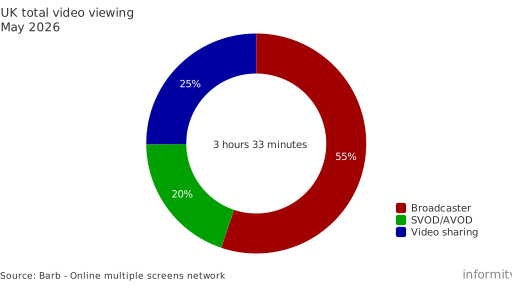
Yet it is a similar picture for other online video subscription and advertiser supported platforms. Barb measures 19 such services but only includes viewing through a home Wi-Fi network. On that basis, it amounts to 40 minutes a day, with over 36 minutes viewed on television.
Compare that with total sharing of video sharing services like YouTube, TikTok and Twitch. They are watched for an average of approaching 20 minutes a day out of over 50 minutes a day viewing such services, slightly less than how much they are watched on television. That slightly misleading, as Barb only measures video sharing services when they are viewed through a home network, so does not count any out of home viewing.
It is not simply that video sharing services are necessarily watched by different demographics. Their combined monthly reach is just under 50 million people in the United Kingdom, of 76.8% of the population, not far behind broadcast viewing.
The difference may be that video sharing services were designed to be viewed online, even if nearly 40% of their viewing as measured by Barb is now on a television screen. In reality, much more viewing of online video sharing services is likely to be on personal screens outside the home.
Some broadcasters seem to think the answer is to make their programming available on video sharing platforms like YouTube. Perhaps they might consider if collectively they can only account for less than a minute a day of mobile viewing why that will make a significant difference.