
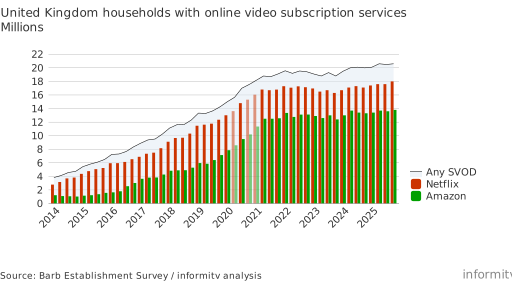
18 million homes in the United Kingdom had access to Netflix at the end of 2025. That is over six out of ten homes. The number is up by 440,000 from 17.6 million the previous quarter, making it the third largest quarterly gain in recent years. Almost seven out of 10 homes in the country had access to an online video subscription service.
The quarterly establishment survey from audience measurement organisation Barb provides a barometer of service adoption. It shows that 20.6 million homes or 69.7% of households in the United Kingdom had access to an online video subscription service at the end of 2025. That is up slightly on 20.5 million the previous quarter.
18.0 million homes, or 60.9% of the country, had access to Netflix. 6.9 million of them, 23.3% of homes in the country, or 38% of Netflix homes, were on its advertising tier, up from 6.1 million the previous quarter.
13.8 million homes, 46.5% of all homes, had access to Amazon Prime Video, up from 13.6 million the previous quarter. 11.9 million of them, 40.3% of homes, were in its advertising tier. That is 40.3% of homes in the country.
7.6 million homes had access to Disney+, which is 25.8% of households, up slightly from 7.5 million the previous quarter. 2.6 million of them, of 8.8% of homes, were on its advertising tier, up from 2.3 million the previous quarter.
Paramount, Discovery+, and Apple TV+ also all saw increases in subscriptions, to 3.5 million, 3.4 million, and 3.0 million respectively. NOW from Sky was flat at 2.0 million homes.
It seems clear that online video subscriptions are not only a challenge to traditional broadcasters in terms of viewing, but a real threat in terms of advertising. While commercial television still has better overall national reach, Netflix and Amazon can potentially address 23% or 40% of the country respectively.
YouTube also represents a threat to commercial television advertising revenue. YouTube is keen for it to be viewed as a form of television but seems less keen to be measured as such.
Parent company Google says that Barb is in contravention of its agreements in the way it measures YouTube. Although the way that Barb chose to report YouTube viewing was somewhat selective, it did suggest that pre-school animation Peppa Pig was the most viewed ‘channel’ on YouTube.
Justin Sampson, who will step down as chief executive of Barb in 2026, once a replacement is appointed, has written that it is difficult to argue for equivalence in commercial and social impact while resisting equivalence in scrutiny.
“Some platforms argue they are now central to television viewing and should be treated accordingly,” he writes in The Media Leader. “Yet that claim carries an implied social and commercial responsibility: participation in the same independent, transparent measurement frameworks that underpin trust elsewhere in the market.”