
The way people search for television is changing rapidly, as conversational artificial intelligence becomes embedded in everyday tools and interfaces. New research from Gracenote, a Nielsen company, suggests that behavioural change is already well underway, particularly among younger audiences, but trust in AI-generated results has yet to keep pace.
Usage of AI chatbots is rising across all age groups, with two thirds of consumers reporting increased use over the past year. Among Generation Alpha, who are now entering their teens, adoption is even more pronounced, with 80% using chatbots more frequently and over half using them daily.
The research is based on an online survey of over 4,000 users of AI chatbots in the United States in early 2026.
While on average just over half of those surveyed said they preferred traditional search, that fell to just over a third for those aged 13-14, among whom 46% said they preferred AI.
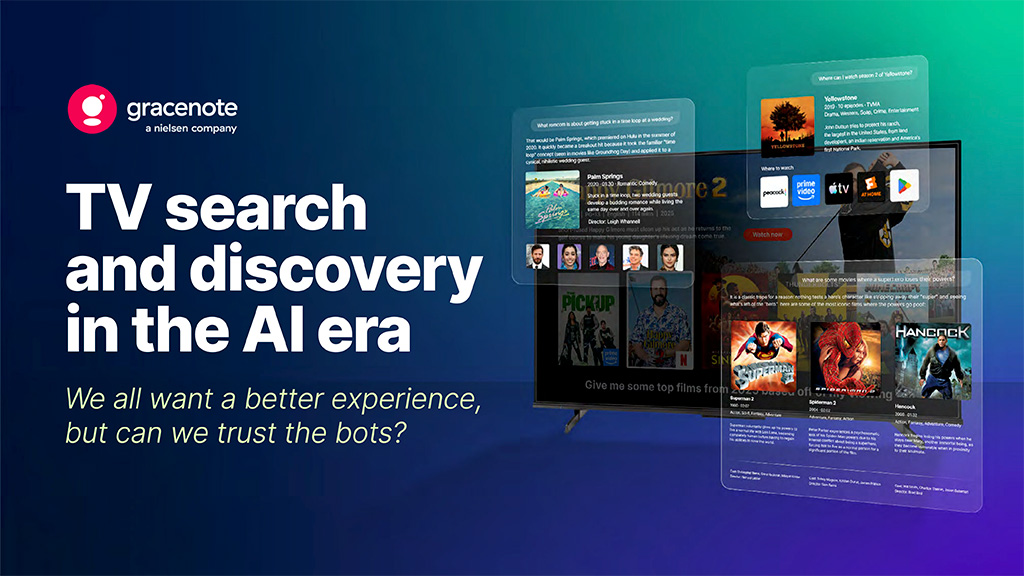
The appeal is clear. AI offers a more conversational and flexible way to search, enabling users to ask complex questions, refine results, and receive direct answers. Across multiple use cases, from recommendations to follow-up queries, consumers show a strong preference for AI over traditional search tools.
However, this shift exposes a significant gap between utility and trust. While users favour AI for convenience and depth, traditional search still leads on perceived accuracy and reliability. Three quarters of respondents say they verify chatbot results, often by cross-checking with conventional search engines.
This tension reflects a fundamental characteristic of large language models. Unlike traditional databases, they do not simply retrieve information but generate responses probabilistically. This allows for richer, more contextual answers, but also introduces the risk of plausible inaccuracies, or ‘hallucinations’. As the report notes, these systems must be ‘grounded’ in trusted, real-world data sources if they are to deliver reliable results at scale.
The stakes are particularly high in entertainment. As content libraries expand across hundreds of services and platforms, discovery has become a growing source of friction. Audiences are spending more time searching, and many report frustration with the abundance of choice. In this environment, AI has the potential to simplify navigation, personalise recommendations, and surface content that might otherwise remain hidden.
At the same time, the effectiveness of these experiences depends heavily on the quality and completeness of the underlying data. Even relatively simple queries, such as where to watch a specific programme, remain inconsistent across current AI systems. Without accurate and up-to-date information, AI risks reinforcing uncertainty rather than reducing it.
Gracenote expects large language models to become the default technology underpinning content discovery. As AI becomes more deeply integrated into devices and services, consumers are likely to rely on it increasingly as a gateway to entertainment.
The implication for the industry is clear. Success will depend not only on the sophistication of AI interfaces, but on the ability to connect them to authoritative, structured data sources. In a fragmented market, trusted data may prove to be the critical factor in turning AI-driven discovery from a promising capability into a dependable experience.
In that context, the emerging foundations of television discovery are beginning to align. Discovery platforms like the Service List Registry, based on open standards including DVB-I, provide a framework for identifying and locating services across networks and platforms. Combined with authoritative metadata and programme information from providers such as Gracenote, these elements point towards a more coherent model for search and discovery.
As artificial intelligence becomes the interface through which audiences navigate programming, it will depend on this underlying ecosystem of trusted data and structured services to deliver results on which viewers can depend.
TV search and discovery in the AI era: We all want a better experience, but can we trust the bots? is published by Gracenote and is available from its web site.