
“The licence fee in its current form is unsustainable simply because there are fewer and fewer people paying it.” So said the Culture Secretary in the United Kingdom. That was in response to the suggestion from the new Director General of the BBC that the television licence was “no longer fit for purpose”.
Answering questions from the members of the Culture, Media and Sport Committee, Matt Brittin was refreshingly transparent.
He described the licence fee as “yesterday’s model”. He said: “It is a busted flush. It is no longer fit for purpose, and that is why we need to make the case for the BBC and a shift in the licence fee model.”
“What I see, coming in fresh, is that the BBC is locked into yesterday’s model of consumption — the licence fee being payable on linear television and iPlayer — when the world has moved on. Consumers are living in tomorrow’s world today, so we need to look again at the mechanism for funding the BBC as part of Charter.”
He said: “It is held back, I think, by the straitjacket of the current licence fee mechanism, which is obviously no longer fit for purpose.”
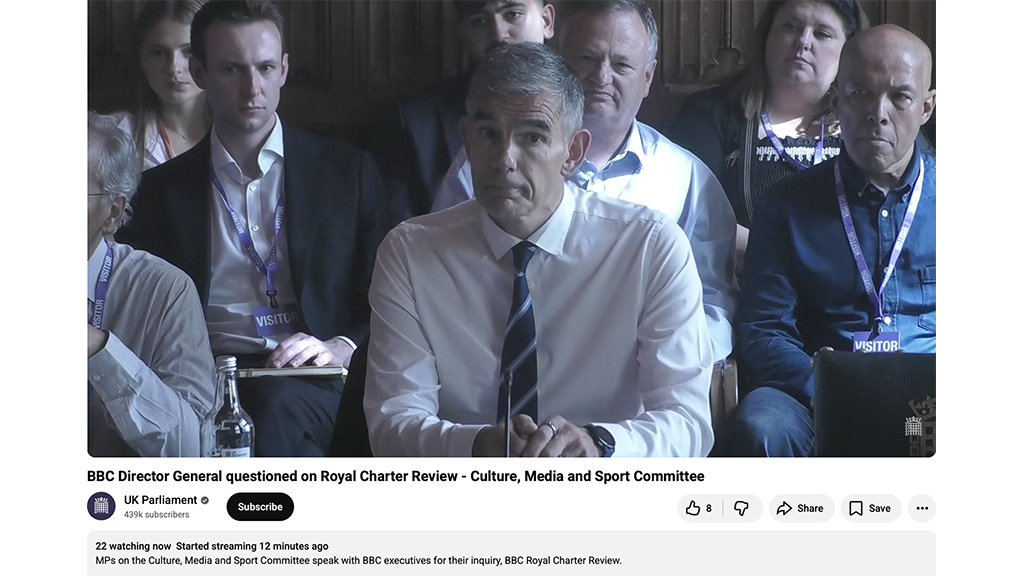
His BBC chairman, Dr Samir Shah, was more reserved, keeping his options open, saying: “the important thing here is that a modernised licence fee must capture the way people are now consuming content, particularly the younger generation.”
Asked whose job it was to communicate about the licence fee, the BBC chairman initially could not hear the question and then fumbled a response that the chair of the committee described as a “word salad”. She turned to the new director general and asked him the same question and he responded with calm confidence.
Overall, the former Google executive seemed remarkably on top of is new role, six weeks into the job, and was impressively persuasive. He looked like an executive who acknowledged the corporate challenge, rather than his predecessors who have been more determined to defend the indefensible.
The Culture Secretary, Lisa Nandy, was asked on the BBC Today programme, whether she agreed that the licence fee was no longer fit for purpose. She was equally frank, saying: “I do, actually. I’ve thought for a long time that the licence fee, in its current form, is unsustainable, simply because there are fewer and fewer people paying it.”
“You can either allow the BBC to go into a period of managed decline, or you can ask people to pay more… so we’re looking at all options. The only option that we have ruled out completely is funding the BBC through general taxation because of the risk of political interference.”
“We have made no decisions about this,” she said. “We’re determined to get this right. What is not negotiable is that we will fund the BBC properly. That is a commitment that we have made. What is up for negotiation is how we do that, because it has to be sustainable and it has to command public support.”
It represents a striking change of position for the BBC, which has long argued for the television licence as a form of funding.
As recently as March 2026, the corporation suggested that the funding model needs reform, with fewer than eight out of ten households paying for a television licence, with income falling by nearly a quarter in real terms over the last ten years.
In its response to the government Charter Review green paper, the BBC wrote: “We need a modernised public funding mechanism that can support a universal public service. One that is fair and affordable, sensitive to the pressure on households from the cost of living and fits with a modern media environment. This should include options to ensure collection and enforcement is fair, proportionate and effective.” It did concede: “we are willing to consider radical options for future funding.”
The consultation asked: “To what extent do you agree that the licence fee should continue to fund a wide range of services and output that aim to inform, educate and entertain audiences?”
The BBC responded at the time: “We strongly agree that the licence fee should continue to fund a wide range of services that inform, educate and entertain.”
On the question of reforming the licence fee, it wrote: “We agree that reforming the scope of the licence fee should be considered to support the BBC’s long‑term sustainability.”
Finally, it noted: “The BBC’s current funding model is unsustainable and requires reform.” It ended: “We are open to new funding models, provided they are fair, sustainable and futureproof, ensuring the BBC remains a service for everyone.”
It seems that under new management, the BBC may be taking a more open position in the hope of a better long-term settlement.
The select committee proceedings were watched live on YouTube by a peak live audience of precisely 63 viewers, including at least one reporting on them.