
After years of speculation about the future of terrestrial television in the United Kingdom, the government has published a long-awaited media Green Paper. It offers something both more significant and less dramatic than many expected. There is no announcement of a date to switch off digital terrestrial television. The government considers 2034 or 2044 as future milestones for television distribution. The document opens a consultation on how public service media should evolve as audiences increasingly watch television online.
The Green Paper recognises that “people are increasingly going online for their content, as global video platforms continue to grow and traditional broadcast viewing is declining in the UK”. Among younger audiences, video sharing services have already overtaken both streaming and broadcast television.
Rather than focusing on preserving traditional broadcasting, the paper proposes supporting the BBC’s transition “from a traditional public service broadcaster, once rooted in linear television and radio channels, to a public service media entity, fit for the platform age”.
The government says it will work with the BBC and other public service media providers to develop “a strategic response to the opportunities and challenges presented by the digital world”. It wants to establish the BBC as “a trusted, public values leader in new technology”, develop “a public service platform strategy”, and “future-proof broadcast services”.
The document highlights Freely, launched in partnership by the BBC, ITV, Channel 4, and Channel 5, allowing viewers to stream live and on-demand television over broadband without an aerial or satellite dish. It describes this as an example of public service media providers adapting together as more people access content through streaming rather than digital terrestrial television.
Those looking for a timetable for turning off digital terrestrial may be disappointed. The Green Paper is exactly that: a consultation. It poses questions rather than providing firm answers and leaves significant policy decisions for the future.
The paper does outline two possible planning horizons. One reflects the current policy framework, with existing digital terrestrial television arrangements extending to 2034, while an alternative scenario considers continuing those services until 2044 to allow a more gradual transition. The consultation seeks views on these options rather than proposing a definitive switch-off date.
In doing so, the consultation keeps open the principal options advocated by different parts of the industry, inviting views rather than signalling a preferred direction.
There is little reference to particular technologies or standards, like DVB-I. The document talks extensively about platforms, connected devices, streaming services, and public service media, but remains largely technology neutral about how those services should be discovered and presented to viewers.
That may prove to be an opportunity rather than a weakness. If the future of television is defined less by transmitters and more by trusted services available across connected devices, then the challenge becomes one of discovery, navigation, and interoperability rather than simply distribution.
The era of broadcast television is not ending overnight. The Green Paper makes one thing clear: government thinking has shifted from protecting traditional channels to ensuring that public service media continues to reach audiences wherever and however they choose to watch.
Beyond the question of when, or whether, digital terrestrial television might end, the Green Paper suggests that the bigger policy challenge is discovery rather than distribution. Questions of prominence, navigation, and trusted public service media on connected platforms receive at least as much attention as transmission networks. For an industry increasingly defined by streaming, that may prove to be the more consequential debate.
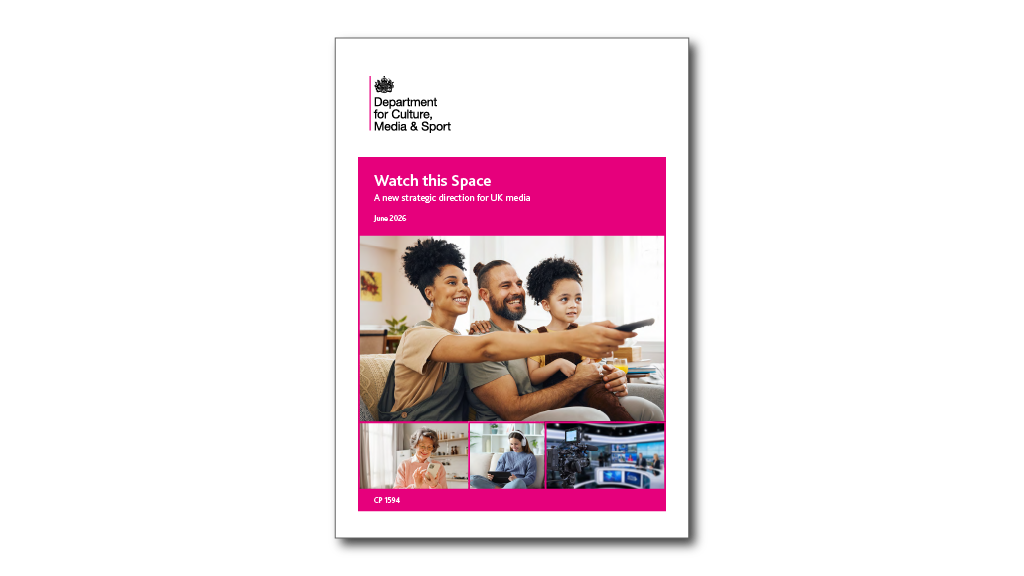
Watch this space: a new strategic direction for UK media – green paper and public consultation is published by the Department for Culture, Media and Sport and is available from the government web site.