
More than half a century after Apollo 11, Artemis II once again brought live pictures from a crewed mission to the Moon to a global audience, capturing the collective imagination of people across our planet. The technology has changed almost beyond recognition, but some of it is now in consumer products. The experience may feel remarkably familiar, but the image quality is more consistent with our modern expectations.
The Apollo missions relied on analogue television cameras, scanning at low resolution at 10 frames a second, and transmitted over narrowband radio links. The iconic images were fragile, often noisy, and required careful conversion for broadcast.
By contrast, Artemis II is designed from the outset as a digital media mission. At the heart of the on-board imaging system are multiple cameras, including ruggedised action cameras supplied by GoPro.
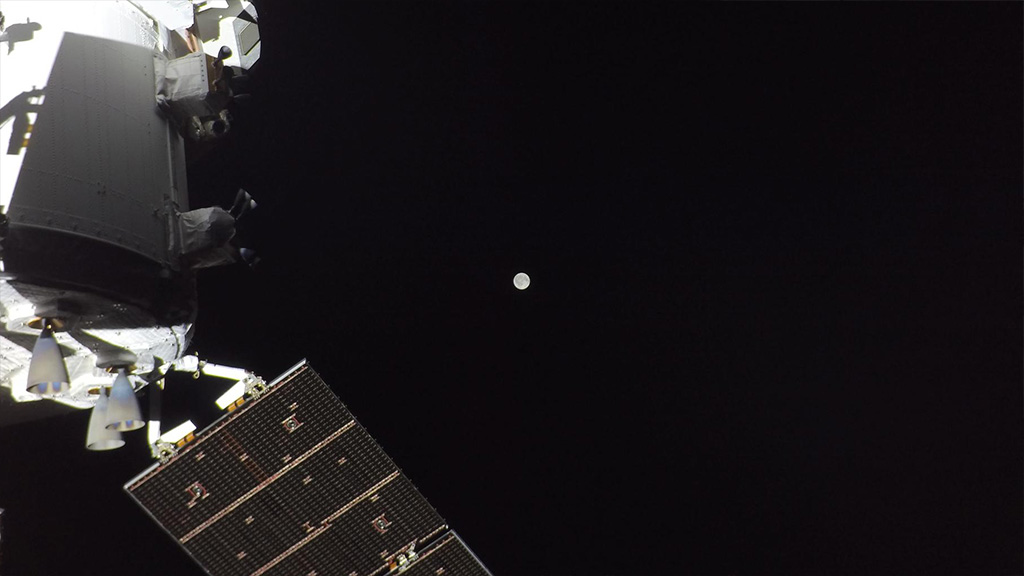
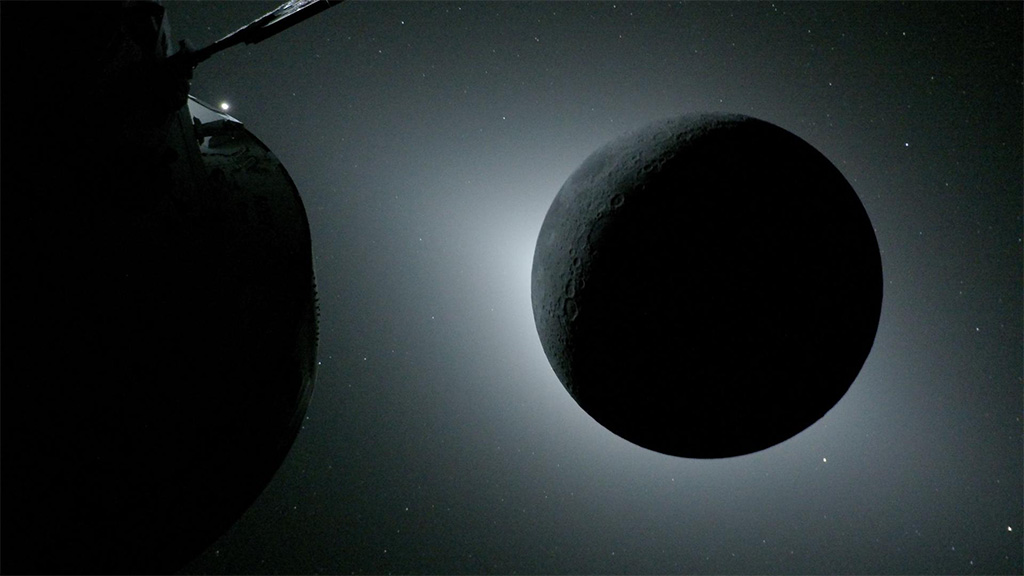
Four modified GoPro cameras were mounted on the solar array wings of the Orion spacecraft, where they captured high resolution views of the spacecraft, Earth, and the Moon, and also served as inspection tools.
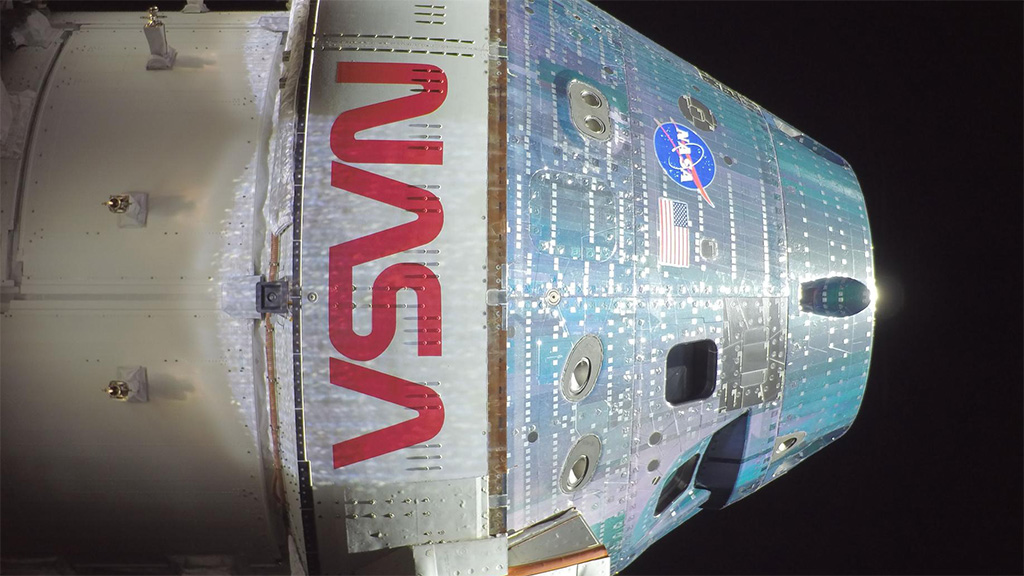
The choice of technology derived from consumer products is deliberate. Modern action cameras offer high resolution, wide dynamic range, and low-light performance in a small, robust form factor. They can operate in constrained environments and provide multiple simultaneous viewpoints without adding significant mass or complexity. Digital video could also be stored on board at high quality for later use, as well as supporting a live feed to Earth.
NASA is deploying a hybrid communications architecture that combines established radio-frequency systems with advanced optical links.
The radio systems provide reliability and continuity. They are well understood, resilient, and form the backbone of deep space communications.
The optical system can transmit far more data than traditional radio, enabling higher resolution video over vast distances. It operates at data rates of up to 260 megabits per second down to Earth, significantly higher than conventional deep space radio systems.
The semiconductor laser uses infrared wavelengths similar to those that are widely employed in fibre-optic telecommunications. By the time the beam reaches Earth, it is about 6 kilometres in diameter. That requires incredibly precise pointing to ground stations.
Once received on Earth, the signals are processed, decoded, and distributed through conventional broadcast and digital workflows.
In effect, the deep space segment becomes an extension of the contribution network. The familiar chain of acquisition, contribution, production, and distribution still applies, but with the first link originating hundreds of thousands of kilometres away.
It is tempting to frame Artemis II as a technological leap from Apollo. In many respects, it is.
Yet the essential experience remains unchanged. A small group of astronauts, travelling far from Earth, sharing their journey with those watching from home.
In the Apollo missions, the limitations of the technology added to the sense of distance. The images were ghostly, delayed, and sometimes uncertain. Viewers leaned in, aware that what they were seeing was extraordinary.
With Artemis II, the images were clearer, more stable, and more immediate. Multiple camera angles brought viewers closer to the crew and the spacecraft. The production values are higher, but the emotional connection may be much the same. The apparent informality of the video, in an era of smartphones, belies the extraordinary scale and inherent danger of the mission.
These are pictures from deep space, where astronauts gain a unique perspective of our planet. There is still the shared moment of anticipation as events unfold live. There is still the collective audience, connected through broadcast and digital media, experiencing it together.
Fifty years ago, the lunar landings defined what television could do. Now it seems almost routine to deliver high-quality video live from deep space, using cameras similar to those we might use to record our own adventures. The next small step on the Moon may once again become a defining moment for a new generation of viewers, for all humanity.