
European broadcasters are resisting moves to reopen the debate on radio frequencies used for television, even as some countries prepare for a future without digital terrestrial television. The European Broadcasting Union argues that it is premature to revisit the international settlement on the spectrum used for television. Behind the technical arguments is a more fundamental question: should international spectrum policy determine when countries give up terrestrial transmission?
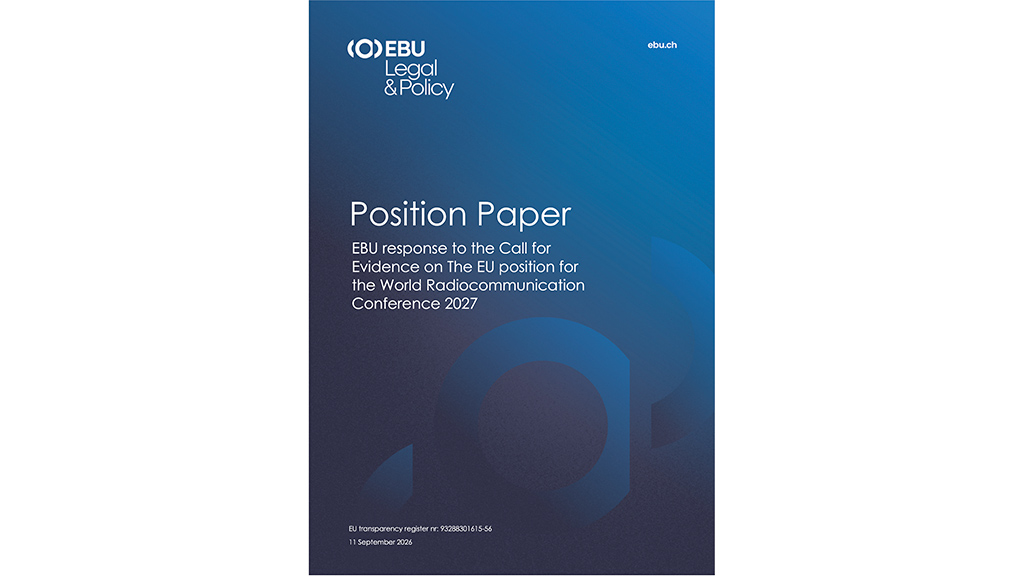
The EBU made its case in a submission to the European Commission as it develops a common European position for the next World Radiocommunication Conference, WRC-27, which will take place in 2027.
The submission is largely concerned with protecting access to spectrum used in programme production, including wireless cameras and video links. The EBU argues that spectrum access underpins the ability of public service media to deliver radio, television and emerging services to audiences.
It says that European policy should also recognise the wider significance of spectrum. The EBU says that “the relevance of spectrum policy for cultural and linguistic diversity” and “media pluralism” should be respected, together with the role of individual member states.
The potentially more significant issue for the longer term concerns the spectrum between 470 and 694 MHz, which is widely used for digital terrestrial television, or DTT. WRC-27 is not being asked to decide the future of this television band. The argument is about what should be considered at the following conference, WRC-31.
The EBU opposes proposals for further studies on mobile use of part of this spectrum with a view to possible regulatory changes at WRC-31. It argues that implementation of decisions already taken at WRC-23 is still being explored, while European regulators are separately considering how the band might be used more flexibly at a national level.
In effect, the EBU is saying that we have only just reached a compromise, countries are still working out what it means, so do not schedule another international negotiation before it has been implemented.
Importantly, this is not simply a demand that spectrum should be reserved for broadcasting indefinitely. The EBU argues that countries which continue to require terrestrial television should not find their ability to provide it constrained by international spectrum decisions.
That raises the question of whether this was not already settled at the last World Radiocommunication Conference in 2023.
WRC-23 produced what the EBU subsequently described as “an excellent outcome for broadcasting”. Broadcasting remained the only region-wide primary service in the 470-694 MHz band across ITU Region 1, which includes Europe, Africa and the Middle East. A proposed region-wide mobile allocation was not agreed, although individual countries gained greater flexibility for mobile use.
Yet WRC-23 also put the UHF band back on the agenda for WRC-31. The conference is due to review spectrum use and the requirements of broadcasting and mobile services and consider possible regulatory action.
There are effectively three clocks running.
The international clock runs through the ITU and its World Radiocommunication Conferences, with WRC-31 representing the next significant review point. The European clock is slightly different. EU legislation safeguards the availability of 470-694 MHz for DTT and programme production until at least 2030, according to national needs.
The European Commission reported on the future of the band in July and noted that the existing framework provides long-term investment predictability for DTT and programme production. At the same time, demand for this valuable spectrum continues to evolve.
Then there are the national clocks, and different countries are moving at very different speeds.
In Sweden, commercial broadcasters have progressively withdrawn from DTT, leaving a reduced terrestrial platform carrying public service channels.
Spain is moving in the opposite direction. DTT remains the principal means of receiving television for the overwhelming majority of households, and the country is investing in its future, with a transition to DVB-T2 enabling more services to be broadcast in ultra-high definition.
The government in the United Kingdom has committed to maintaining DTT until at least the end of 2034 but is now explicitly planning for its eventual withdrawal. Its recent green paper proposes a managed switch-off either at the end of 2034 or following a limited extension to the end of 2044.
From a British perspective, therefore, fighting internationally to preserve spectrum for terrestrial television might appear increasingly academic. If the United Kingdom is preparing to turn off DTT, why should it matter whether the spectrum remains protected for broadcasting?
The answer is that spectrum availability and spectrum use are two different policy questions.
Retaining an allocation for broadcasting does not require a country to continue using terrestrial television. A country such as the United Kingdom can still decide that its audiences, infrastructure and market are ready to move elsewhere.
Changing the international regulatory environment can have the opposite effect. Once spectrum is progressively reassigned, national choices may become constrained by neighbouring countries, interference considerations, equipment markets and investment decisions. A country that still depends heavily on terrestrial television could find that a decision has effectively been made for it.
That helps explain why the EBU is seeking to slow the international process even while the future of DTT is being actively reconsidered in individual countries.
The underlying argument is less about defending a particular transmission technology than preserving national options. Different countries have different levels of terrestrial viewing, broadband availability, public service obligations and approaches to universal access. They may reasonably reach different conclusions about how long terrestrial television remains necessary.
The debate is therefore not simply broadcasting against mobile, or old technology against new. It is also about European harmonisation and national discretion at a time when television distribution strategies are beginning to diverge.
The United Kingdom is increasingly asking when it can switch off terrestrial television. Other countries may still be asking how long they need it. The EBU is posing a prior question: who should have the authority to make that decision?