
YouTube TV, the multichannel service available in the United States, is forecast to become the largest subscription television service in the country by 2027. That will be due to the dramatic decline in traditional pay television subscriptions and the consistent growth of YouTube TV as a virtual multichannel video programming distributor.
At the end of 2025, Charter is the leading subscription television service provider in the United States, under the Spectrum brand, with 11.4 million subscribers. It is now ahead of Comcast, with 10.6 million subscribers.
YouTube TV now has an estimated 9.3 million subscribers, although some estimates put it past 10 million. The last official numbers from Google had it at 8 million in February 2024. In July 2022 it had 5 million.
The YouTube TV service was launched in 2017 in five major markets in the United States, expanding nationally by early 2019. It includes unlimited network digital video recording that saves programmes for up to nine months. It is available across a range of smart televisions and online video players and is not tied to any particular internet service provider.
Omdia forecasts that Charter will decline to 10.0 million subscribers by 2027, while Comcast will fall to 9.2 million. Meanwhile, it predicts that YouTube will reach 10.4 million subscribers.
While no-one can predict the future, it is not unreasonable to extrapolate from recent trends, which do point to YouTube TV becoming the leading television platform in the United States.
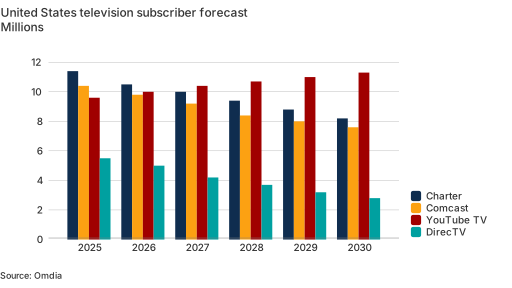
In practice, Charter and Comcast operate in different geographic markets and co-operate in many areas, including their joint venture online video platform. So, together they have 21.8 million subscribers, which is far more than YouTube TV, but fewer than Comcast alone had ten years ago.
Although people can argue about whether YouTube is television, there is no doubt that YouTube TV is multichannel television as we know it. YouTube TV emerged as a clear competitor to traditional television services from incumbent cable companies.
“For the first time in US television history, the largest pay-TV operator will be a virtual provider,” said Maria Rua Aguete, the head of media and entertainment at Omdia. “YouTube TV has evolved into a full pay-TV bundle, integrating linear channels, premium networks, and marquee sports properties such as NFL Sunday Ticket. This is not just another streaming service; it is the new face of US pay TV.”
Then there is YouTube itself, which takes a substantial share of television viewing in the United States and has nearly 3 billion users around the world.
“Netflix may reach 300 million global subscribers, but alongside YouTube’s 3 billion users, it is not a dominant global player,” Maria added. “YouTube operates at a scale that no subscription service can match.”
“The idea of Netflix as a dominant streaming service is a misconception,” she said. “Audience attention and spend are spread across a wide array of platforms.”
Although it has the most subscribers among online video services in the United States, Netflix only accounts for 15.7% of all such subscriptions in the country.
Netflix has an estimated 88.7 million subscribers in the United States, while Amazon Prime Video has an estimated 64.7 million, Disney+ 55.8 million, Paramount+ 49.4 million, and HBO Max an estimated 29.7 million.
After Netflix successfully bid $82.7 billion to acquire the Warner Bros Discovery movie and television studios as well as the HBO Max online service, Paramount Skydance has launched a hostile bid for the whole of Warner Bros Discovery, valued at $108.4 billion. We must wait and see how that story unfolds.