
Total television viewing in the United States was at a 12-month high in January 2026, up by 3.7% over December. Cable channels saw a percentage point gain in share of overall viewing, while online fell back fractionally to 47% of all television viewing. Although it has risen rapidly in recent years, it has yet to pass half of all television viewing. It could exceed that in the second half of 2026. Broadcast channels still account for one in five viewing hours, and the number of homes with an antenna is rising.
Time spent watching online video on television was up 2.7% month on month, as reported by The Gauge from Nielsen.
Netflix saw a 1% monthly increase in viewing to take 8.8% of total television viewing, which was down from 9.0% in December. Netflix ranks third by distributor, behind YouTube and The Walt Disney Company.
YouTube took a 12.5% share of total television viewing, down slightly on the previous month and from a high of 13.4% in the Summer.
Disney had a 4.9% share of viewing, including Disney+, ESPN+, and Hulu. That was up slightly on the previous month, but slightly less than a high of 5.0% earlier the previous year.
Amazon Prime Video accounted for 4.1% of viewing, down slightly on December but up on every other month in 2025.
Online viewing may be approaching just under half of all television viewing, but traditional channels still account for over four out of ten hours spent watching television, with live sports an important part of that.
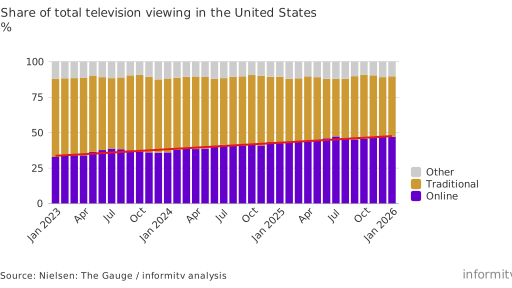
Taking a glass slightly less than half full perspective, broadcast channels still account for 21.5% of all television viewing, with subscription channels at 21.2%. Put another way, broadcast channels were still watched more than Netflix, Disney+, ESPN+, Hulu, and Amazon Prime Video combined.
However, if the current trend continues, online could exceed a 50% share of all television viewing in the United States by the second half of 2026.
Interestingly, the number of households in the United States with over the air antennae has been rising over the last year, to 23.7 million homes, as measured by Nielsen, out of a universe of around 128 million homes, or about 18.5% of households. That is up by 22% year on year and up by 36% over four years.
This could be driven by the cost of living, the availability of ATSC 3.0 NextGen TV, or the realisation that a combination of freely available channels complemented by online video services is for some an adequate substitute for traditional pay television services.